
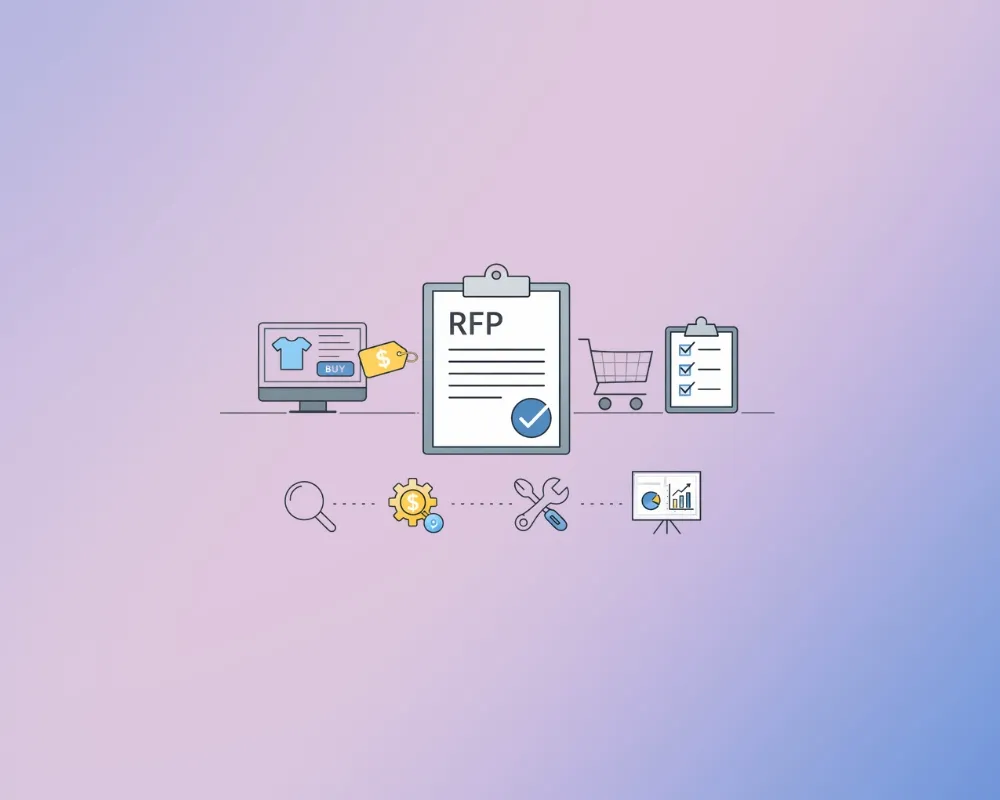

Choosing the right commerce partner is a long-term business and operational investment that directly affects revenue growth, scalability, and organizational efficiency.
Research from Deloitte shows that nearly 70% of digital transformation initiatives fail to achieve their intended outcomes when they lack alignment with broader business strategy and rely on subjective success metrics rather than measurable financial impact.
This is where an ecommerce RFP makes a difference. As a strategic tool, it determines whether potential partners align with the organization’s business model, operational complexity, integration landscape, and long-term growth objectives.
The quality of the questions included in an ecommerce RFP is the key differentiator, revealing how vendors approach architecture, scalability, delivery predictability, risk management, governance, and ongoing optimization within complex enterprise ecommerce environments spanning integrations, pricing models, custom workflows, and distributor networks.
Below are 10 questions organizations can use when developing an ecommerce RFP template to move beyond surface-level vendor comparisons and identify partners capable of supporting both immediate and long-term ecommerce transformation.
An effective ecommerce RFP aligns organizational requirements with future objectives by identifying scalable platforms and partners. This ensures the ecommerce RFP looks beyond present-day features and reduces the risk of selecting solutions that cannot support new sales channels, markets, or business models.
In turn, vendors must demonstrate an understanding of the organization’s business model, growth plans, operational complexity, and required ecommerce platform functionality over the planning horizon including the ability to support business evolution through:
Addressing long-term business alignment in an ecommerce RFP shifts evaluation toward vendors with a strategic approach to long-term platform viability, including scalability, adaptability, and total cost of ownership, enabling a more sustainable commerce foundation and business expansion.
Every business has goals, constraints, and technical complexity such as legacy systems, integration requirements, organizational processes, and scalability considerations. In ecommerce, where complex pricing, custom catalogues, account management, and ERP integrations are common, vendors with experience navigating these challenges are better positioned to anticipate risks and avoid costly missteps.
An ecommerce RFP should therefore assess delivery capability by validating whether vendors have successfully delivered similar projects. To support vendor evaluation over the planning horizon, the ecommerce RFP template can incorporate the following:
Incorporating these elements into the ecommerce RFP vendor selection requirements ensures evaluation of proven delivery experience rather than theoretical readiness. This facilitates prioritization of vendors with proven ecommerce implementations, success stories, and documented lessons learned.
Many ecommerce projects encounter issues such as inconsistent estimates and misaligned proposals, particularly when multiple workflows, customer hierarchies, pricing models, and system integrations are involved. An ecommerce RFP can address these challenges by assessing how business goals are translated into documented, actionable requirements through the following:
Defining discovery and requirements in the RFP is a foundational part of ecommerce RFP vendor selection requirements, helping identify vendors that prioritize planning and clarity over early estimates. This results in more accurate proposals, fewer change orders, and a seamless transition from strategy to execution.
Given requirements such as real-time pricing, inventory visibility, customer-specific catalogues, and account hierarchies, integration expertise is essential in ecommerce. However, system integrations are among the most challenging aspects of commerce projects, and many organizations continue to rely on legacy RFP templates that were once effective but place limited emphasis on integration strategy or technical depth.
.jpg)
As a result, integration planning becomes a key indicator of delivery readiness. The ecommerce RFP should surface how vendors intend to connect the commerce platform with core business systems, such as ERP, CRM, PIM, OMS, marketing automation, and fulfillment, revealing their approach to architecture, data flow, and long-term maintainability by examining the following:
Integration planning should be reflected in the discovery process and carried through to scope, timelines, and pricing, particularly in ecommerce initiatives with complex system dependencies.
Addressing this in an ecommerce RFP reduces the risk of unexpected technical challenges, budget overruns, and timeline extensions, while improving the likelihood of selecting a partner that understands the ecommerce storefront and the broader technology ecosystem.
The decision to rely on out-of-the-box or custom functionality represents a core architectural consideration in any commerce project. When built-in capabilities are well understood, many requirements can be met through configuration rather than custom development.
This distinction informs how built-in features and customization are evaluated within the ecommerce RFP, with attention to trade-offs between speed, cost, flexibility, and long-term maintainability, by examining:
These considerations within an ecommerce RFP template reduce the risk of over-engineered solutions and fragile custom codebases, while prioritizing partners that design sustainable architectures capable of evolving with the business.
Performance, scalability, and uptime have a direct impact on revenue, customer experience, and brand trust. As a result, ecommerce RFPs benefit from highlighting how performance and reliability are established and maintained, particularly across different business models such as B2B and B2C ecommerce, where large orders, complex catalogues, and integration-heavy workflows place sustained pressure on infrastructure.
An ecommerce RFP should therefore require vendors to demonstrate how their proposed solution is designed to operate under real-world conditions, including traffic spikes, seasonal demand, peak-order volumes, integration load, and long-term growth, by outlining:
Requiring vendors to address performance, scalability, and uptime in the ecommerce RFP reduces the risk of slow sites, outages, and reactive fixes, while enabling organizations to select partners that support stability and growth from the outset.
Ecommerce environments should establish security standards and regulatory requirements to protect customer data, payment information, and business systems.
Given the elevated risk exposure associated with payment information, customer data, customer-specific contracts, and integrated systems, ecommerce platforms are frequent targets of cyber threats.
These include attack patterns such as malicious JavaScript injection into storefront code to capture payment details during checkout, reinforcing the importance of establishing security and compliance controls within the ecommerce RFP vendor selection requirements, including:
Security and compliance expectations within an ecommerce RFP reduce operational, financial, regulatory, and reputational risk by ensuring shortlisted vendors meet governance and data protection requirements before implementation begins.
Standardized ecommerce RFP templates result in proposals with high-level timelines that lack sufficient detail to assess feasibility or risk, producing unrealistic expectations and delivery uncertainty. To address this, an ecommerce RFP should present an execution roadmap that emphasizes:
Well-defined timelines, roles, and risks in an ecommerce RFP provide transparency into how delivery will be managed, enabling more informed planning, reducing delivery risk, and increasing confidence in implementation outcomes.
An ecommerce RFP template that focuses primarily on implementation while leaving ongoing services and support undefined makes it difficult to evaluate long-term fit. Without defined post-launch expectations, organizations risk selecting partners who can deliver a project but cannot effectively support, scale, or optimize the platform over time.
Ongoing support and optimization therefore serve as key indicators of a vendor’s long-term partnership model. The ecommerce RFP should outline requirements for post-launch services and maintenance across the commerce platform lifecycle, surfacing how vendors plan to sustain platform stability, adapt to change, and drive continuous enhancement through the following areas:
Addressing ongoing support and optimization in an ecommerce RFP reduces long-term operational risk and reinforces a stable, adaptable commerce foundation beyond initial implementation, contributing to improved site performance, customer experience, and business growth.
Case studies and client references validate delivery capability and credibility. To enable objective, evidence-based comparisons that align proposals with business needs, an ecommerce RFP template should specify the proof vendors are expected to provide, including:
Establishing documented evidence requirements in an ecommerce RFP supports informed vendor evaluation and reduces reliance on claimed capabilities, enabling organizations to assess consistency, execution discipline, and long-term delivery performance before selecting a business partner.
Whether developing an ecommerce RFP, refining an RFP template, or navigating complex vendor selection requirements, the right advisory partner enables successful outcomes.
Tidal Commerce provides advisory support across platform evaluation, architecture planning, and implementation strategy to help teams make confident, informed decisions. Connect with us to learn how we can support your ecommerce RFP process.


Blog
All
Blog
All
.webp)
Blog
All
.webp)
Blog
All
Blog
All
Blog
All
.webp)
Blog
All
Blog
All

Blog
All

Blog
All
Blog
All
.webp)
Blog
All
Blog
All
.webp)
Blog
All
.webp)
Blog
All
.webp)
Blog
All
.webp)
Blog
All
.webp)
Blog
All
Blog
All
.webp)
Blog
All
.webp)
Blog
All
.webp)
Blog
All
Blog
All
.webp)
Blog
All
Blog
All
.webp)
Blog
All
.webp)
Blog
All
.webp)
Blog
All

Blog
All
.webp)
Blog
All
.webp)
Blog
All
Blog
All
.webp)
Blog
All
Blog
All


Get monthly insights, case studies, and bold ideas from the front line of digital commerce & CX.
.svg)
%20dashboard%20showing%20demand%20and%20inventory%20data.%20(1).png)
.webp)

.webp)
.webp)
.webp)
.webp)
.webp)
.webp)
.webp)
.webp)
.webp)

.webp)
.webp)
.webp)
.webp)
.webp)
.webp)
.webp)
.webp)
.webp)
.webp)
.webp)
.webp)
.png)
.webp)
.webp)
.webp)