

Enterprise commerce is advancing toward an era defined by digital innovations, rising consumer expectations, composability, and experience-first growth. This guide looks at the benefits, challenges, new trends, and important strategies that business leaders should think about when selecting ecommerce platforms for their companies in 2026.
Enterprise commerce is the strategy that enables established and expanding B2B and B2C organizations to manage service and product exchanges across digital and non-digital channels. It supports high-volume transactions, large-scale inventories, multiple storefronts, and localized pricing and delivery.
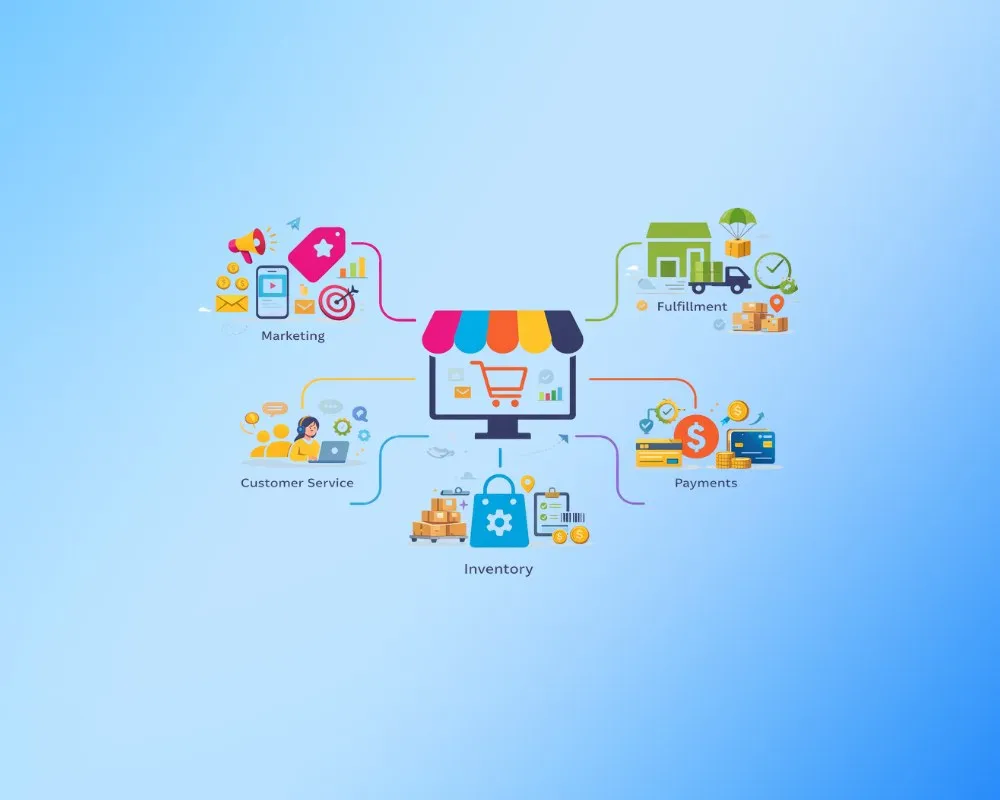
Enterprise commerce, including monolithic, composable, and headless architectures, connects core systems such as marketing platforms, payment services, ERP, CRM, OMS, PIM, CMS, CDP, and analytics to unify data across teams and enable personalized, cohesive, omnichannel customer experiences.
At its core, enterprise commerce supports brands in building a digital ecosystem that drives market expansion and enhances customer experience and operations throughout the commerce lifecycle.
Enterprise headless commerce plays a critical role in this ecosystem by decoupling the experience layer from core systems, enabling greater agility and scalability across channels, while composable commerce allows organizations to assemble and evolve best-of-breed capabilities without platform lock-in.
As digital innovations evolve and disrupt industries, customer expectations for seamless, customized virtual experiences and services across channels continue to increase. Despite this, UX-related issues—such as unexpected costs and inefficient checkout experiences—drive an average cart abandonment rate of 70.19%, according to the Baymard Institute.
When businesses continue to rely on legacy systems, they introduce UX challenges that limit their ability to meet the speed, complexity, and expectations of modern commerce. With 70–80% of IT budgets tied up in maintaining traditional infrastructure, digital transformation becomes unavoidable to deliver consistent, high-quality digital experiences.
While expanding into global markets has become more accessible, doing so without the right infrastructure remains challenging. Enterprise ecommerce platforms enable brands to scale internationally while maintaining control over data, operations, and regional complexity.
Enterprise commerce consists of an ecosystem of integrated systems that support the full customer journey, from browsing to post-purchase engagement. Rather than relying on a single platform, businesses increasingly adopt a flexible set of tools to improve speed, agility, and scalability.
.jpg)
Together, these components allow organizations to evolve and scale their enterprise ecommerce capabilities over time while preserving core systems and operational stability.
Enterprise ecommerce adoption equips organizations with the foundation needed to compete, scale, and operate efficiently in an increasingly digital landscape.
Ultimately, enterprise commerce adoption provides the structural flexibility needed to adapt as technologies, channels, and customer expectations continue to evolve, positioning organizations for sustained growth.
Despite its benefits, implementing enterprise ecommerce introduces complexity that organizations must plan for. Without a clear strategy, initiatives risk delays, cost overruns, and reduced return on investment. Key challenges include:
Addressing these challenges early enables organizations to implement enterprise commerce with greater confidence, reduce risk, and position the platform for long-term success.
Adopting an enterprise commerce platform impacts every part of the organization. To make the right investment, business leaders should define a clear strategy and align on objectives before execution by considering the following questions:
Clarify business goals such as revenue growth, improved customer experience (CX), operational efficiency, or expansion into international markets. Ensure these objectives align with the broader business strategy and long-term vision.
Assess existing systems (ERP, OMS, CRM, and others), internal technical capabilities, training requirements, managed service partners, and cybersecurity readiness.
Define KPIs such as conversion rate, average order value (AOV), site performance, retention, fulfillment accuracy, and customer satisfaction to track progress and demonstrate ROI.
Evaluate future growth plans, anticipated traffic increases, new channels, and the ability to add or replace capabilities, such as checkout, search, CMS, or order management, without major rework.
Establish ownership, decision-making structures, timelines, and organizational alignment to ensure consistent execution and accountability.
When these considerations are addressed upfront, organizations are better positioned to make informed enterprise commerce decisions that support sustainable growth and avoid costly replatforming efforts.
Customers increasingly expect seamless, connected shopping experiences, while internal teams need real-time data, streamlined workflows, and intuitive tools that reduce manual effort and support faster decision-making. As both technology and customer expectations continue to evolve, businesses must balance speed, flexibility, and advanced functionality. These pressures are accelerating a set of trends that are redefining enterprise commerce.
Enterprise ecommerce platforms establish the foundation for faster adaptation to evolving market and technology trends.
Enterprise ecommerce platform decisions should be grounded in both current business needs and long-term strategic goals. Evaluating solutions across business alignment, technical fit, and operational readiness helps ensure sustained success.
With the right approach, platform selection lays out the foundation for sustainable outcomes and future-ready commerce operations. Organizations exploring enterprise commerce may benefit from expert guidance to assess platform options and align them with business requirements.
Enterprise commerce platforms support different architectures and business needs. The examples below highlight enterprise commerce vendors and how organizations have used them to scale and modernize commerce operations
Whether you are evaluating enterprise commerce platform options, assessing technical constraints, or analyzing total cost of ownership, experienced guidance can help clarify complex decisions.
Tidal brings hands-on expertise supporting organizations through platform evaluation, architecture planning, and implementation considerations. Tidal provides advisory support to help organizations navigate these decisions with clarity and confidence, contact us.


Blog
All
Blog
All
.webp)
Blog
All
.webp)
Blog
All
Blog
All
Blog
All
.webp)
Blog
All
Blog
All

Blog
All

Blog
All
Blog
All
.webp)
Blog
All
Blog
All
.webp)
Blog
All
.webp)
Blog
All
.webp)
Blog
All
.webp)
Blog
All
.webp)
Blog
All
Blog
All
.webp)
Blog
All
.webp)
Blog
All
.webp)
Blog
All
Blog
All
.webp)
Blog
All
Blog
All
.webp)
Blog
All
.webp)
Blog
All
.webp)
Blog
All

Blog
All
.webp)
Blog
All
.webp)
Blog
All
Blog
All
.webp)
Blog
All
Blog
All


Get monthly insights, case studies, and bold ideas from the front line of digital commerce & CX.
.svg)
%20dashboard%20showing%20demand%20and%20inventory%20data.%20(1).png)
.webp)
.webp)

.webp)
.webp)
.webp)
.webp)
.webp)
.webp)
.webp)
.webp)
.webp)

.webp)
.webp)
.webp)
.webp)
.webp)
.webp)
.webp)
.webp)
.webp)
.webp)
.webp)
.webp)
.png)
.webp)
.webp)
.webp)