
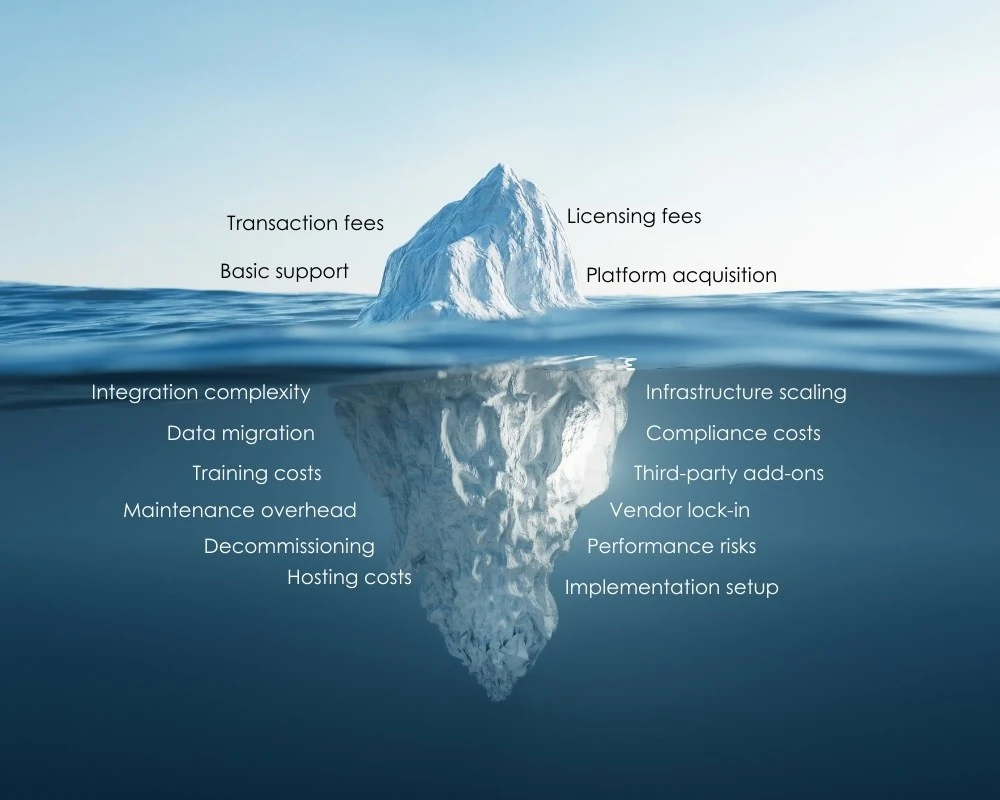
For enterprise buyers evaluating commerce platforms, the conversation often starts with licensing fees. Initial acquisition costs dominate early comparisons, and one option may appear significantly less expensive than another.
But focusing only on price is where costly mistakes begin.
Gartner finds that 80% of tech buyers suffer post-purchase regret. That regret typically stems from expenses that surface after implementation: unexpected integration work, extended training, downtime, capability gaps, and rising maintenance fees. When organizations evaluate platforms based solely on sticker price, they overlook the majority of their financial exposure.
This is why total cost of ownership (TCO) analysis is critical, and why ecommerce TCO has become a strategic discipline for enterprise organizations.
Total cost of ownership reframes commerce platform selection by looking beyond licensing fees to the full cost curve. Instead of evaluating a platform based only on acquisition cost, ecommerce TCO analysis accounts for:
Many of these costs do not appear clearly in vendor proposals. A months-long integration effort can quietly drain internal teams. Managed services fees accumulate over time. Long-term maintenance may exceed expectations.
Indirect costs further complicate the picture. Process redesign, change management, and user adoption challenges do not show up in contracts, yet they frequently drive overruns and delays.
What looks competitive on paper can shift dramatically once the total cost of ownership is fully modeled.
Avoiding budget blowouts requires cross-functional alignment. Finance, IT, operations, and end users all see different cost drivers, from depreciation and integration complexity to workflow impact and user training demands.
For example, one eCommerce retailer found that while a platform’s license fees appeared lower, a complete ecommerce TCO analysis, including implementation, transactions, hosting, and long-term support, revealed that the lower-priced option was actually more expensive over time.
This is the power of evaluating the total cost of ownership instead of just the upfront cost.
Beyond headline pricing, contractual details can significantly reshape total cost of ownership.
Vendor lock-in clauses, proprietary integrations, and exit penalties can add millions to transition costs. Some platforms restrict which payment processors can be used, preventing businesses from leveraging pre-negotiated rates and introducing hidden fees.
Additional ecommerce TCO risk factors include:
Unplanned downtime or performance degradation during peak seasons can erode revenue and customer trust. Maintenance cycles, hardware refreshes, and third-party dependencies often grow faster than anticipated.
Without robust ecommerce TCO modelling, these risks remain invisible until they become budget shocks.
Organizations that treat total cost of ownership as a proactive strategy avoid surprises and preserve long-term flexibility.
At Tidal Commerce, TCO analysis is delivered as a transparent, interactive framework designed to turn abstract comparisons into quantifiable insights.
Recently, Tidal Commerce supported a client evaluating two leading eCommerce platforms.
At first glance, one option appeared cheaper due to lower licensing fees. However, there was limited clarity around transaction costs, hosting, long-term maintenance, and platform customizability for the client’s complex requirements.
By running a tailored ecommerce TCO analysis, Tidal mapped the full cost curve across implementation, licensing, payment processing, infrastructure, and ongoing support.
The result was a transparent view of each platform’s total cost of ownership, enabling leadership to understand both budget impact and long-term strategic alignment.
The payoff: budget accuracy, clarity, accountability, and confidence before contracts were signed.
Total cost of ownership is more than a procurement checklist. It is a framework for long-term resilience in digital commerce.
By surfacing the full cost curve early, organizations:
Instead of chasing the lowest bid, companies that apply ecommerce TCO invest with foresight, balancing today’s budgets with tomorrow’s scalability, innovation, and continuity. In enterprise commerce, the lowest price rarely equals the lowest cost.
Whether you're comparing ecommerce platforms, modernizing your architecture, deploying core systems such as commerce, OMS, PIM, CRM, or ERP, or building the integrations that unify them into a cohesive operating model, understanding the total cost of ownership before rollout is critical.
For a clear, comprehensive view of your full project cost, contact us for a hassle-free consultation. We’ll help you model the complete cost curve.


Blog
All
Blog
All
.webp)
Blog
All
.webp)
Blog
All
Blog
All
.webp)
Blog
All
Blog
All
Blog
All
Blog
All

Blog
All
Blog
All
.webp)
Blog
All
Blog
All
.webp)
Blog
All
.webp)
Blog
All
.webp)
Blog
All
.webp)
Blog
All
.webp)
Blog
All
Blog
All
.webp)
Blog
All
.webp)
Blog
All
.webp)
Blog
All
Blog
All
.webp)
Blog
All
Blog
All
.webp)
Blog
All
.webp)
Blog
All
.webp)
Blog
All
Blog
All
.webp)
Blog
All
.webp)
Blog
All
Blog
All
.webp)
Blog
All
Blog
All


Get monthly insights, case studies, and bold ideas from the front line of digital commerce & CX.
.svg)
%20dashboard%20showing%20demand%20and%20inventory%20data.%20(1).png)
.webp)
.webp)

.webp)
.webp)
.webp)
.webp)
.webp)
.webp)
.webp)
.webp)
.webp)

.webp)
.webp)
.webp)
.webp)
.webp)
.webp)
.webp)
.webp)
.webp)
.webp)
.webp)
.webp)
.png)
.webp)
.webp)
.webp)