
.webp)

Digital commerce has replaced physical aisles with search, filters, and faceted navigation that determine how customers locate and evaluate products and services. When these discovery tools do not surface relevant results, customers abandon their searches and disengage from the shopping journey.
Industry research estimates that over $300 billion in U.S. retail revenue is forfeited annually due to search abandonment. Much of this friction stems from fragmented product data, which prevents search engines and filters from returning accurate matches.
This article examines how Product Information Management (PIM) enhances search performance and filtering precision by organizing product data to facilitate efficient exploration and informed purchase decisions.
In ecommerce, how easily customers can find the products and services they need directly impacts conversion and revenue growth.
Research from the Baymard Institute reports that findability influences whether users can identify, assess, and buy items. A separate Baymard study found that 31% of product-finding attempts fall short when users rely on a website’s search functionality, exposing direct revenue risk.
However, when discovery tools perform as intended, the upside is substantial. Visitors who use on-site search are 2-3 times more likely to convert, according to Forrester Research, highlighting the value of effective catalogue navigation.
Product and service discovery is, therefore, tied to commerce performance. When filters and category browsing guide customers to their desired offerings, organizations benefit from higher conversion rates, accelerated buying decisions, and increased average order value (AOV). Ultimately, sustaining these advantages consistently depends on how well companies manage product information across their commerce storefronts.
Fragmentation occurs when product data varies across systems, suppliers, or catalogue frameworks. These breakdowns stem from data management issues such as:
These conditions distort how product data is structured, stored, and distributed across systems, creating inconsistencies that affect downstream commerce experiences.
Consequently, organizations encounter operational and customer-experience impacts such as:
Over time, these data challenges compound as product assortments expand, increasing operational demands and undermining the overall commerce experience.
In turn, these constraints can be addressed with product information management software, which centralizes, standardizes, and governs product data, enabling commerce platforms to operate on a unified data foundation.
With consistent product data in place, organizations can begin to define the attributes, taxonomy, and enrichment processes that power product information for digital commerce.
Building on this foundation, product data enrichment accelerates the depth and quality of product records, while controlled distribution ensures that trusted information reaches commerce platforms, search systems, and other digital channels. Together, these practices strengthen merchandising oversight and enable the expansion of product and service portfolios without increasing operational complexity.
Within a product information management system, discovery-ready product data is supported through functions such as:
As a result, when product data is managed through PIM, commerce platforms can categorize items more effectively, allowing product assortments to expand without introducing discrepancies in classification and product information.
A product information management software enables organizations to manage product information across their catalogues, supporting the search, refinement, and navigation capabilities required for effective product and service discovery. This produces the following benefits for businesses:
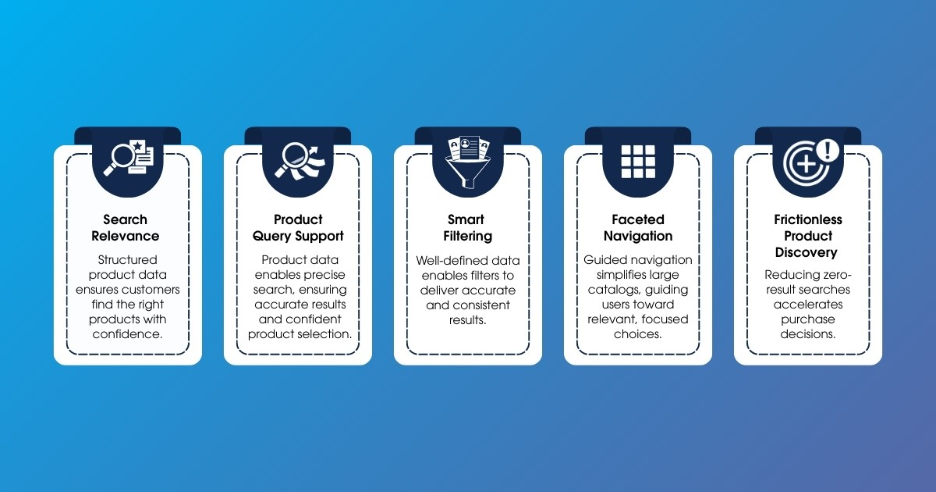
Additionally, enriched product data support search systems in interpreting user intent beyond basic keyword matching, improving results for both targeted searches and exploratory browsing. Consistent data values ensure filters reflect product distinctions rather than conflicting entries.
Moreover, faceted navigation provides structured pathways through product catalogues, guiding users across attributes such as size, compatibility, material, or use case to simplify product sets into manageable comparisons.
Together, these capabilities enhance how offerings are surfaced and evaluated across product and service portfolios.
Organizations adopting product information management software such as Akeneo and inriver to elevate the performance of ecommerce search, filtering, and faceted navigation demonstrate outcomes such as:
Collectively, these outcomes illustrate how product information management (PIM) influences how offerings are surfaced, refined, and explored in digital commerce.
Tidal Commerce partners with organizations to implement Product Information Management (PIM) strategies that enhance search, filtering, and navigation. We align product data, technology, and operating models to help teams manage product information and guide initiatives from strategy through execution.
If you would like to discuss your PIM needs or are looking for advice on a PIM vendor, connect with us, our team will be happy to support you.


Blog
All
Blog
All
.webp)
Blog
All
Blog
All
Blog
All
.webp)
Blog
All
Blog
All

Blog
All

Blog
All

Blog
All
Blog
All
.webp)
Blog
All
Blog
All
.webp)
Blog
All
.webp)
Blog
All
.webp)
Blog
All
.webp)
Blog
All
.webp)
Blog
All
Blog
All
.webp)
Blog
All
.webp)
Blog
All
.webp)
Blog
All
Blog
All
.webp)
Blog
All
Blog
All
.webp)
Blog
All
.webp)
Blog
All
.webp)
Blog
All

Blog
All
.webp)
Blog
All
.webp)
Blog
All
Blog
All
.webp)
Blog
All
Blog
All


Get monthly insights, case studies, and bold ideas from the front line of digital commerce & CX.
.svg)
%20dashboard%20showing%20demand%20and%20inventory%20data.%20(1).png)
.webp)
.webp)

.webp)
.webp)
.webp)
.webp)
.webp)
.webp)
.webp)
.webp)
.webp)

.webp)
.webp)
.webp)
.webp)
.webp)
.webp)
.webp)
.webp)
.webp)
.webp)
.webp)
.webp)
.png)
.webp)
.webp)
.webp)