
.webp)

Customer journeys span online platforms, in-store environments, and service channels, with buyers moving between interactions throughout the purchase cycle. Research shows that 80% of consumers consider the shopping experience as equally important as a company’s offerings, raising the stakes for operational consistency at every interaction.
Meeting these expectations requires coordinated execution across inventory, order management, and logistics, supported by order management systems that orchestrate order flow and inventory availability to ensure accurate commitments at every stage.
This article explores how order management serves as a unified coordination layer across ecommerce, stores, fulfillment networks, and service operations, connecting inventory visibility, intelligent routing, and exception resolution throughout the entire customer journey.
Omnichannel engagement sets a baseline expectation for consistency across touchpoints. The journey encompasses discovery, evaluation, transaction, order execution, and post-transaction engagement, forming a unified experience.
As omnichannel engagement becomes standard behaviour, customer expectations rise accordingly. Buyers expect inventory data to be accurate, delivery commitments to be reliable, and interactions to remain consistent across channels. Each instance of engagement reinforces brand perception and directly impacts conversion, loyalty, and lifetime value.
Delivering this level of consistency requires coordination throughout the commerce ecosystem, including ecommerce platforms, stores, marketplaces, and distribution networks that generate data and fulfillment demands. When these elements operate in coordination, the experience becomes seamless and intentional.
Ultimately, the customer journey is defined by how effectively operations are synchronized to support each stage; orchestration aligns availability, order execution, visibility, and service interactions to ensure continuity across the order lifecycle.
Once a shopper places an order, a series of operational processes are triggered across systems responsible for inventory validation, payment authorization, order routing, shipping coordination, and status updates. The Order Management System (OMS) manages these processes, coordinating execution across the systems and teams responsible for delivering the order.
OMS evaluates inventory availability across distribution centers, stores, and other fulfillment locations to determine where the order should be sourced. Throughout the process, the order management system synchronizes information across commerce platforms, warehouse systems, logistics providers, and service tools. This ensures that inventory levels remain accurate, shipping updates propagate across channels, and consumers and support representatives have access to the latest order status.
By consolidating events such as order capture, allocation decisions, processing activities, shipment confirmation, and delivery updates, the OMS creates a shared operational record of the order lifecycle, enabling teams and systems to act on consistent, real-time data.
At their core, order management solutions serve as an enterprise orchestrations layer, aligning systems and teams to manage distributed inventory, support multiple distribution models, and ensure reliable order execution at scale.
At some point, most online shoppers encounter the consequences of inaccurate inventory data. A shopper discovers a product through an advertisement, navigates to the retailer’s website, selects the preferred size and colour, and proceeds through checkout. Shortly after the order confirmation arrives, a second message follows: the item is out of stock, and the order cannot be fulfilled.
Situations like this occur when inventory data is not accurately synchronized across ecommerce platforms, stores, and distribution locations, affecting the purchase experience and the likelihood of repeat purchases.
OMS relies on consistent stock data across warehouses, stores, suppliers, and in-transit inventory to maintain consistent product availability across every customer engagement point.
According to CAPS Research, in 2024 the average inventory accuracy across businesses was approximately 83%, compared to nearly 95% among top-performing organizations. This means roughly 17% of inventory records may be incorrect, leading to products appearing available when they are not, orders being cancelled after checkout, delayed fulfillment or split shipments, inefficient store or warehouse picking, and increased customer service escalations and refunds.
Moreover, consumer expectations continue to escalate alongside digital transparency. Research indicates that 69% of online shoppers abandon purchases and turn to competitors when preferred items are out of stock, underscoring the revenue and brand implications of unreliable inventory information.
When availability data is dependable, organizations can present credible delivery timelines, support flexible order execution models, and reduce cancellations driven by stock discrepancies.
This synchronized visibility also enables intelligent allocation, multi-node fulfillment agility, and reliable commitments across channels, while enhancing productivity by identifying stock that can be deployed from alternate locations.
By creating a single, authoritative view of available inventory, the Order Management System (OMS) establishes the foundation for coordinated orchestration across the customer journey, enabling confident commitments, optimized execution, and scalable performance across the enterprise.
Order Management System (OMS) enables dynamic allocation by determining the most efficient sourcing path once an order is confirmed. It directs the order to the appropriate location based on factors such as transportation speed and expenses, geographic proximity, and operational capacity.
This enables organizations to support ship-from-store, warehouse distribution, in-store pickup, and hybrid scenarios while balancing commitments with operational constraints.
These execution decisions are shaped by factors such as:
McKinsey highlights the business impact of fulfillment speed; they found that nearly half of omnichannel shoppers will choose another retailer when timelines take longer than expected, while processing expenses can reach 10-20% of sales, making optimization a strategic priority within order management.
By automating sourcing decisions in real time, organizations enhance delivery reliability while preserving workflow efficiency at scale. This approach minimizes split shipments, reduces last-mile distance, and strengthens service performance throughout the customer journey.
Delivery commitments shape consumer trust. Order Management System (OMS) enables real-time shipment promises by evaluating inventory availability, fulfillment capacity, and routing options as conditions change.
OMS platforms support the entire order lifecycle, from sourcing and processing to tracking, exception management and customer notifications. When disruptions occur, automated updates keep buyers and service teams aligned.
These capabilities position order management as a safeguard for high-quality customer experiences and trust.
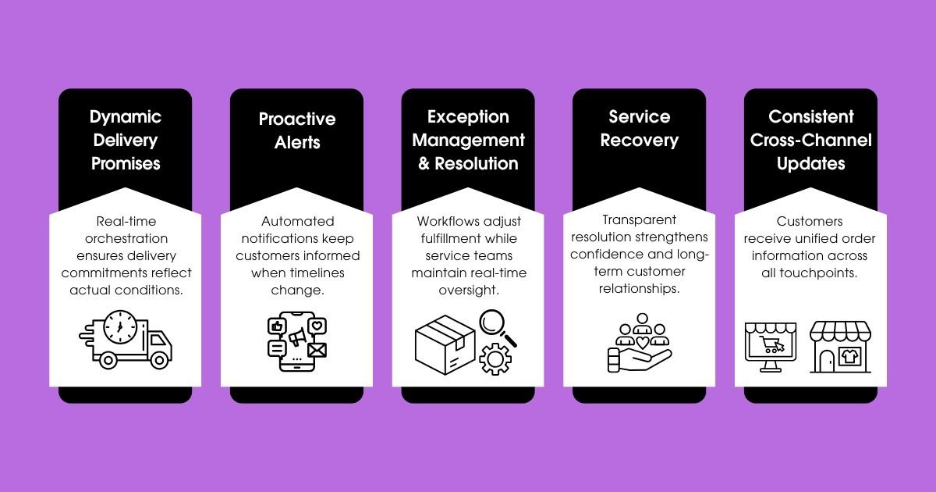
When commitments align with actual conditions and recovery is managed effectively, service reliability becomes a competitive advantage.
The buyer journey continues after delivery. In fact, how organizations manage post-purchase interactions determines whether a transaction becomes a repeat purchase or a one-time interaction.
Order Management Systems (OMS) orchestrate post-order workflows by coordinating return initiation, routing, inventory disposition, and refund processing across channels. This coordination enables organizations to offer flexible return and exchange options while controlling cost and operational efficiency, allowing stores, warehouses, and logistics providers to handle returns consistently while protecting inventory value and consumer trust.
When post-purchase orchestration aligns returns, reverse logistics, and process insight, returns move from being an operations expense to a capability that strengthens buyer confidence and improves inventory productivity and merchandising decisions.
As OMS orchestrates orders across channels and fulfillment nodes, it also generates a continuous stream of operational data, from sourcing decisions to order completion and customer inquiries. This shared visibility connects supply chain activity with consumer experience outcomes and enables more informed business decisions.
Over time, this operational data reveals how orders move through the distribution network and how execution decisions influence service quality, cost-to-serve, and overall efficiency.
By connecting how orders are executed with consumer experience outcomes, order management enables organizations to identify improvement opportunities, refine fulfillment strategies, and align teams around service performance. In this way, the OMS functions as an intelligence layer that enhances reliability, efficiency, and customer confidence.
The following case studies demonstrate how organizations across industries leverage order management solutions to elevate the customer journey:
These examples illustrate how OMS orchestration translates into operational outcomes. By unifying inventory visibility and order processing, organizations shorten timelines, scale volumes, and align operations across the order lifecycle to support sustained growth.
Tidal Commerce helps organizations design and implement order management solutions that orchestrate the entire customer journey. From defining orchestration requirements to aligning systems, processes, and fulfillment networks, we enable coordinated execution and reliable shopping experiences.
Connect with us to modernize your OMS capabilities and support scalable growth in an increasingly complex commerce environment.


Blog
All
Blog
All
.webp)
Blog
All
.webp)
Blog
All
Blog
All
.webp)
Blog
All
Blog
All

Blog
All

Blog
All

Blog
All
Blog
All
.webp)
Blog
All
Blog
All
.webp)
Blog
All
.webp)
Blog
All
.webp)
Blog
All
.webp)
Blog
All
.webp)
Blog
All
Blog
All
.webp)
Blog
All
.webp)
Blog
All
.webp)
Blog
All
Blog
All
.webp)
Blog
All
Blog
All
.webp)
Blog
All
.webp)
Blog
All
.webp)
Blog
All

Blog
All
.webp)
Blog
All
.webp)
Blog
All
Blog
All
.webp)
Blog
All
Blog
All


Get monthly insights, case studies, and bold ideas from the front line of digital commerce & CX.
.svg)
%20dashboard%20showing%20demand%20and%20inventory%20data.%20(1).png)
.webp)

.webp)
.webp)
.webp)
.webp)
.webp)
.webp)
.webp)
.webp)
.webp)

.webp)
.webp)
.webp)
.webp)
.webp)
.webp)
.webp)
.webp)
.webp)
.webp)
.webp)
.webp)
.png)
.webp)
.webp)
.webp)