
Reducing Overselling and Stockouts with Order Management Systems (OMS)

Overselling and stockouts arise in commerce when inventory is managed across fragmented systems and fulfillment nodes without centralized coordination.  

Research from Harvard reports that stockouts result in nearly $1 trillion in lost global revenue annually, underscoring the financial consequences of inventory misalignment.

As organizations expand across customer touchpoints, maintaining accurate product availability becomes increasingly complex. As a result, inventory data must be synchronized across systems and channels to ensure that customer demand aligns with stock conditions.

This article highlights how Order Management System (OMS) addresses these challenges by acting as a control layer that governs inventory commitments, matches demand with available supply, and orchestrates order execution throughout the commerce ecosystem.

Why Overselling and Stockouts Occur in Commerce

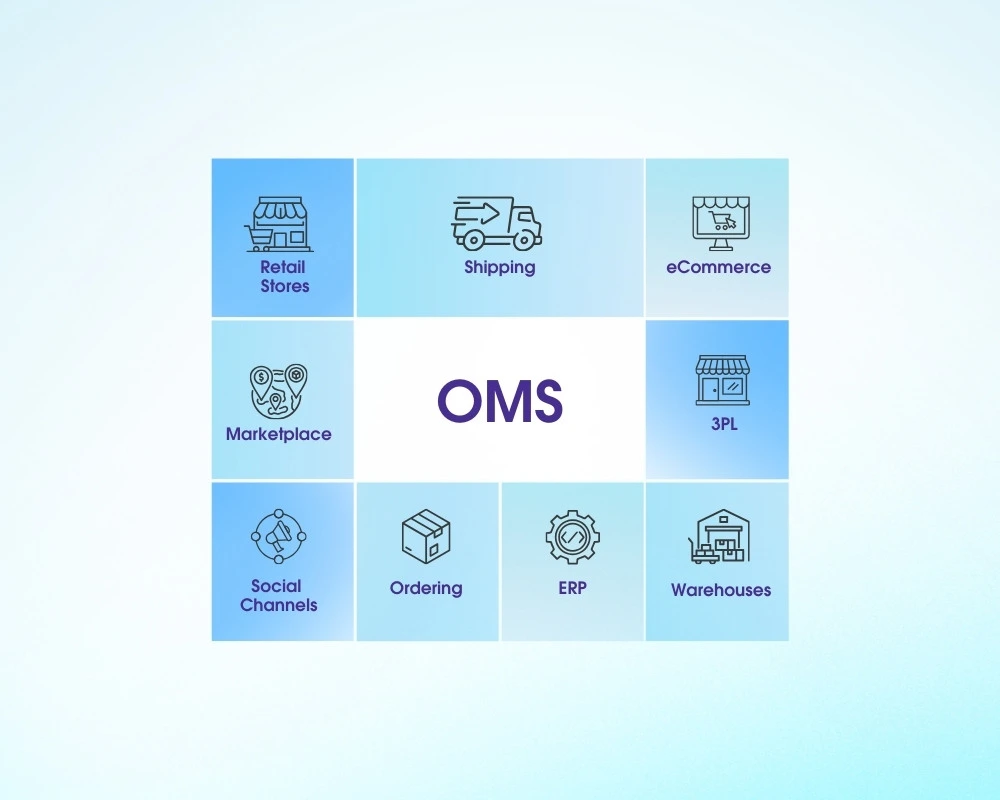
Inventory and order data are stored across various digital platforms, marketplaces, ERP systems, warehouses, stores, and third-party logistics providers. This distribution of data limits real-time alignment between customer demand and fulfillable inventory.

Without coordinated order management, organizations rely on delayed synchronization and disconnected workflows. As a result, products may appear available in one system while already committed in another, creating discrepancies in recorded inventory levels.

At the same time, as order volume and delivery capabilities scale across channels and fulfilment locations, maintaining consistent inventory visibility becomes increasingly difficult, thereby increasing the likelihood of overselling or stockouts.    

Key contributors to overselling and stockouts

  • Fragmented systems that lack coordinated reservation, allocation, and inventory commitment logic across channels and locations  
  • Delayed inventory updates that distort available-to-sell calculations at the point of order
  • Manual intervention that introduces errors and operational overhead  
  • Limited real-time visibility into inventory across distribution networks  

When inventory data is dispersed across systems without an effective and reliable order management software, inventory accuracy declines, resulting in business disruptions caused by overselling and stockouts.

Business Implications of Overselling and Stockouts

Overselling and stockouts carry financial and operational consequences, including order cancellations, lost revenue, margin erosion, and diminished customer trust.

The Netstock Inventory Management Benchmark Report indicates that best-in-class wholesale operations lose about 2.1% of potential sales due to stockouts, while lower-performing organizations forfeit 11–16%, highlighting the commercial impact associated with constraints in order management.  

Product availability also influences customer loyalty. Studies show that 30% of consumers report lower satisfaction when items are out of stock, and 70% switch brands after experiencing ongoing shortages, demonstrating how persistent availability issues undermine long-term customer relationships.

Overselling further compounds these challenges by driving businesses to cancel orders after they have been accepted, increasing service costs and damaging brand credibility.

Together, these breakdowns expose the limitations in inventory governance and order coordination, which contribute to operational disruptions and revenue leakage across commerce channels.

How OMS Extends Inventory Management Capabilities Beyond Visibility

IMS versus OMS comparison infographic

As commerce operations scale, many organizations rely on legacy inventory systems designed to track stock levels and provide inventory visibility. For instance, an Inventory Management System (IMS) maintains stock records and supports warehouse-level operations by:

  • Tracking stock levels and available-to-sell quantities
  • Recording inventory movements and adjustments across locations
  • Supporting location-level allocation and replenishment updates
  • Maintaining accuracy through audits and cycle counts

While IMS stores inventory data at the location level, it does not determine how stock should be committed when various orders compete for the same supply.

An Order Management System (OMS), by contrast, extends these capabilities by synchronizing order decisions in real time and governing how stock is committed to incoming orders.

In commerce environments where demand originates across diverse touchpoints, OMS enables customer promises to reflect fulfillment capacity by:

  • Aggregating orders across channels
  • Verifying inventory status before commitment
  • Applying rules to reserve and allocate stock
  • Triggering downstream processes such as order routing and alerts

Collectively, these features shift inventory management from passive tracking to active commitment control, supporting reliable order execution across the commerce ecosystem.

Cross-Channel Inventory Governance in Distributed Commerce

While an order management system centralizes control over inventory commitments, commerce operations often span ecommerce sites, marketplaces, B2B portals, retail stores, and social commerce channels, with inventory located across distribution centres, stores, and partner facilities and coordinated through a shared inventory pool.

OMS supports this orchestration by consolidating operational signals from ERP systems, warehouse management systems (WMS), store operations, point-of-sale (POS) platforms, and logistics providers. These data sources create a network view of available-to-promise (ATP) inventory that mirrors stock conditions throughout the supply network.

Within the order lifecycle, an order management platform governs inventory through functions such as:

  • Unified order data: Consolidates demand across channels, so orders are evaluated based on current stock levels.
  • Coordinated inventory management: Connects stock across digital and physical commerce touchpoints to ensure availability.
  • BOPIS and curbside pickup: Extends digital ordering to in-store collection and activates store-based inventory.
  • Ship-from-store enablement: Positions retail locations as distribution nodes to increase inventory productivity and accelerate delivery.        
  • Dynamic order routing: Selects shipping locations based on inventory position, distance, cost, and service requirements.
  • End-to-end order visibility: Provides shared visibility into order status and execution progress across systems.

Order management solutions, therefore, stabilize order processing throughout the enterprise while supporting consistent inventory commitments across fulfillment points.

Execution Controls That Support Overselling and Stockouts Reductions

Once inventory governance is established, order management systems apply execution controls that determine how products are committed when an order is confirmed.

Fluent Commerce states that OMS helps prevent inventory imbalances by incorporating demand insights and integrating with planning tools, reducing operational disruptions that can undermine customer loyalty and business performance.  

Order Management System (OMS) embeds these controls within order workflows through the following mechanisms:
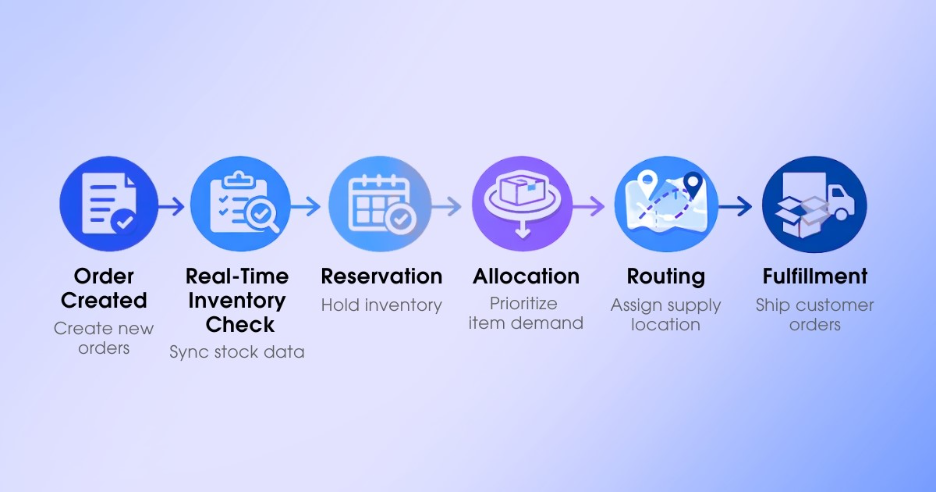
OMS Order Execution Control Flow Diagram

Real-Time Inventory Synchronization  

Inventory records change automatically whenever activity occurs, including recent purchases, shipment confirmations, returns, or stock adjustments. Because these updates occur continuously, each order commitment reflects the most up-to-date product availability at the moment the order is accepted.

Inventory Reservation and Allocation Logic

When an order is placed, an order management platform immediately sets aside the required items, so they cannot be promised to another buyer. This safeguard ensures that competing orders cannot claim the same product.

Intelligent Order Routing and Fulfillment Decisioning

Before finalizing a purchase, the order management system determines which supplier should fulfill the order. If the requested order details cannot be fulfilled exactly as requested, alternatives such as delayed delivery, partial shipments, or product substitutions can be applied to keep the order moving.

Stock Protection Thresholds

Minimum stock buffers protect top-selling products from being overcommitted during periods of heavy demand. When inventory approaches these limits, alerts allow teams to respond before supply drops below acceptable levels.

Demand Monitoring for Replenishment  

Order activity provides insight into how rapidly products are selling and where demand is scaling. These signals support proactive replenishment decisions and help organizations rebalance stock before shortages occur.

Together, these operational practices ensure that product commitments remain consistent as order volume increases, allowing organizations to scale commerce operations while reducing overselling risk and minimizing stockouts.

Commerce Performance Using Order Management System (OMS)

Organizations that leverage a cloud-based order management system, such as Fluent Commerce and PIPE17, demonstrate how enhancing inventory accuracy, increasing visibility across locations, and coordinating order workflows help reduce overselling and stockouts, as illustrated in the following examples:

  • Psycho Bunny reduced short shipments from 30% to 2% by improving inventory accuracy and order orchestration, minimizing fulfillment issues caused by unreliable stock data.
  • Barbeques Galore achieved real-time visibility across locations, cutting excess inventory by 30%, and strengthening stock reliability to support product availability.
  • Athlete’s Foot unified data and enabled ship-from-store delivery, with 95% of orders shipped from stores, expanding inventory access and reducing out-of-stock scenarios.
  • Orthofeet synchronized order and stock data across systems, eliminating duplicate orders and over fulfillment while maintaining consistent inventory levels.
  • Amour Vert aligned inventory levels across stores and its 3PL, enabling smarter order routing and supporting dependable product availability.
  • St. Frank established a unified view across sales and distribution locations while routing orders based on current stock and coordinating bundle components to ensure orders aligned with real-time inventory.

Together, these outcomes demonstrate how order management solutions can support commerce in protecting inventory commitments and fulfilling customer orders as operations scale.

Tidal Commerce partners with organizations to implement order management system (OMS) strategies that help teams manage product commitments and coordinate order processing across complex commerce environments. We align technology, operational processes, and inventory governance practices to help teams maintain reliable product availability and prevent stock imbalances as demand, sales channels, and delivery networks expand.

To explore how stronger order management can reduce overselling and stock-related disruptions, connect with us. Our team will be happy to support you.

Tags:
Inventory management
Share
Blog
:

Latest Blogs & Insights

How PIM Improves Search, Filters, and Faceted Navigation
Product Information Management

Improving eCommerce Search, Filters, and Faceted Navigation with PIM

Patricia Perfas
March 12, 2026

Blog

All

Order Management Systems
Inventory management

How OMS Orchestrates the Entire Customer Journey

Patricia Perfas
March 6, 2026

Blog

All

No items found.

Total Cost of Ownership: How Ecommerce TCO Transforms Platform Decisions

Yazmin Pascual
February 24, 2026

Blog

All

product information management
Product Information Management

Powering Personalization and Product Recommendations in Digital Commerce with PIM

Patricia Perfas
February 18, 2026

Blog

All

eCommerce RFP
No items found.

10 Questions Every Ecommerce RFP Should Include

Patricia Perfas
February 13, 2026

Blog

All

Enterprise commerce
Enterprise Commerce

The Future of Enterprise Commerce: A Leader’s Guide for 2026

Patricia Perfas
January 29, 2026

Blog

All

Composable Commerce
No items found.

Composable Commerce: Why Brands Are Moving Beyond Monolithic Platforms

Yazmin Pascual
January 12, 2026

Blog

All

Food and Beverage
No items found.

Food and Beverage Trends Redefining B2B Digital Commerce

Yazmin Pascual
January 6, 2026

Blog

All

TCO Analysis in eCommerce
No items found.

TCO Analysis in eCommerce: Understanding True Costs

Yazmin Pascual
November 1, 2025

Blog

All

No items found.

The Genesis of Customer Journey 2.0: Navigating the Evolving Ecosystem in a Post-Pandemic World

February 15, 2024

Blog

All

No items found.

How to Determine if Your Brand is Ready for Headless Commerce.

September 19, 2021

Blog

All

No items found.

Understanding and Tackling eCommerce Fraud

November 24, 2023

Blog

All

No items found.

Streamline Holiday Returns: Strategies For Profitable Returns Management

November 24, 2023

Blog

All

No items found.

The Future of eCommerce: Top 11 Trends to Watch in 2024

December 17, 2023

Blog

All

No items found.

Elevate Creativity: Unshackling Your Brand with Modern Content Strategies

October 3, 2024

Blog

All

No items found.

Mark Your Calendars: The Must-Attend eCommerce Events

January 31, 2024

Blog

All

No items found.

Transforming Commerce: The AI Revolution in Retail

January 31, 2024

Blog

All

No items found.

Beyond Convenience: Bridging the B2B/B2C Divide for Explosive Growth in eCommerce

October 9, 2024

Blog

All

No items found.

Is Your eCommerce Platform Stuck in the Past?

February 29, 2024

Blog

All

No items found.

Reinventing the Wheel of Customer Loyalty in the Digital Renaissance: Unveiling Effective Strategies and Opportunities

February 29, 2024

Blog

All

No items found.

The Strategic Symbiosis of Outsourcing and eCommerce Growth

March 6, 2024

Blog

All

No items found.

Enhancing Customer Experience through Advanced Journey Mapping Strategies

March 17, 2024

Blog

All

No items found.

Unleashing the Power of B2B Ecommerce Lead Generation

April 1, 2024

Blog

All

No items found.

Optimizing Site Search: A Strategic Imperative for ECommerce Success

April 1, 2024

Blog

All

No items found.

Beyond the Click: Crafting Unforgettable Customer Experiences for profitable growth.

April 16, 2024

Blog

All

No items found.

Navigating the Digital Shift: A Comprehensive Guide to B2B Website Migration

April 16, 2024

Blog

All

No items found.

How To Choose a B2B Ecommerce Platform for Your Business

April 29, 2024

Blog

All

No items found.

Understanding Enterprise eCommerce Architecture

May 28, 2024

Blog

All

No items found.

Platform Implementation: Tips for Success in Enterprise Commerce

July 2, 2024

Blog

All

No items found.

AI-Powered Personal Assistants and Cybersecurity Innovations

July 2, 2024

Blog

All

No items found.

Shopify in the enterprise

July 15, 2024

Blog

All

No items found.

Navigating B2B Growth and Strategies to Stay Ahead in a Competitive Market

July 29, 2024

Blog

All

No items found.

The Essential Role of Change Management in Transforming Organizations

July 29, 2024

Blog

All

No items found.

How Headless Checkout is Transforming Ecommerce Success

August 11, 2024

Blog

All

No items found.

Data-Driven Success Begins with Robust Business Intelligence

September 5, 2024

Blog

All

No items found.

The 11 Leading Benefits of B2B Ecommerce (2025)

September 16, 2024

Blog

All

No items found.

Unified Commerce: Streamlining Sales Channels and Enhancing Customer Experiences

September 30, 2024

Blog

All

No items found.

Global Trends in eCommerce and Insights for 2025

September 30, 2024

Blog

All

No items found.

Consumerization on Enterprise Technology

October 17, 2024

Blog

All

No items found.

The Future of B2B: How Self-Service is Reshaping Buyer Experiences

October 17, 2024

Blog

All

No items found.

The Evolution of the B2B Customer Journey: Adapting to Modern Ecommerce Buyers

November 4, 2024

Blog

All

Shopify and Zuora in ecommerce
No items found.

Shopify and Zuora Integration: A Game-Changer for eCommerce Development

Yazmin Pascual
November 18, 2024

Blog

All

Simplify complex buying: the role of product discovery in B2B commerce
No items found.

Simplify complex buying: the role of product discovery in B2B commerce

Yazmin Pascual
April 11, 2025

Blog

All

composable commerce
No items found.

Why mid-market enterprises are choosing composable commerce

Yazmin Pascual
April 30, 2025

Blog

All

order management end to end
No items found.

The future of order management: OMS as a strategic advantage

Yazmin Pascual
May 27, 2025

Blog

All

Webinars

Drive your online revenue with SMS

April 11, 2022

Blog

All

Webinars

Driving Growth from the Contact Center.

June 30, 2022

Blog

All

Webinars

Unlocking the next level of store growth with Headless Commerce

January 30, 2023

Blog

All

Webinars

Convert Online Returns to Revenue.

March 23, 2023

Blog

All

Webinars

Turn Post-Purchase Costs Centers Into Revenue Channels

May 2, 2023

Blog

All

Webinars

How to Elevate Customer Services to Drive Loyalty & Revenue

June 1, 2023

Blog

All

No items found.

Why Outsourcing E-commerce Technology Support (ETS) is an Efficient Strategy.

July 7, 2023

Blog

All

No items found.

Elevating Customer Engagement with Personalized Marketing Automation

August 8, 2023

Blog

All

No items found.

Omnichannel Customer Experience – a Strategy to Outperform Competitors.

August 18, 2023

Blog

All

No items found.

Mastering Black Friday & Cyber Monday (BFCM): A Success Blueprint.

October 15, 2023

Blog

All

No items found.

Optimize Year-Round Sales: Comprehensive 2024 Retail Calendar for Strategic Planning and Promotion

August 6, 2024

Blog

All

Let the tide bring you something good.

Get monthly insights, case studies, and bold ideas from the front line of digital commerce & CX.

Thank you! Your submission has been received!
Oops! Something went wrong while submitting the form.
Composable experts
An Umbrella Company
Unified commerce architects
Collaborative partner
Outcomes-driven
Technical leaders