
.png)

Product data is fundamental to how organizations manage operations and deliver customer experiences in commerce. As product assortments expand and distribution channels increase, coordinating product information at scale becomes more challenging.
In response to this growing complexity, companies are turning to artificial intelligence to transform how they operationalize product data across systems. According to Deloitte’s 2026 AI Report, 34% of organizations are using AI to transform their business models, while another 30% are redesigning key processes to incorporate AI.
These changes are reshaping how product data is structured, maintained, and applied across channels. As a result, product information management platforms are evolving to support these demands.
This article highlights how AI is transforming Product Information Management (PIM), including its impact on workflows, governance, and business performance throughout the commerce ecosystem.
As product assortments expand and distribution channels multiply, effective product data practices become a key requirement for commerce operations.
This shift is reflected in market expansion. Grand View Research reports that the global product information management market was valued at $11.49 billion in 2023 and is projected to grow at a 16.7% CAGR from 2024 through 2030, indicating a rising reliance on systems that help synchronize product data across teams, suppliers, and channels.
However, the demands of digital commerce are redefining how organizations manage product information, as manual enrichment, fragmented supplier inputs, and slow update cycles limit data quality and efficiency, impacting time to market and consistency as commerce environments become increasingly complex.
To address these challenges, organizations are embedding artificial intelligence into product data processes, with product information management (PIM) evolving from a centralized repository into an intelligence layer that enables coordinated workflows, improved data accuracy, and accelerated commercialization.
AI supports dynamic, scalable execution of product data tasks across creation, enrichment, classification, and validation, enhancing data reliability and streamlining execution across systems and teams.
In practice, these capabilities are applied across product information management workflows, including:
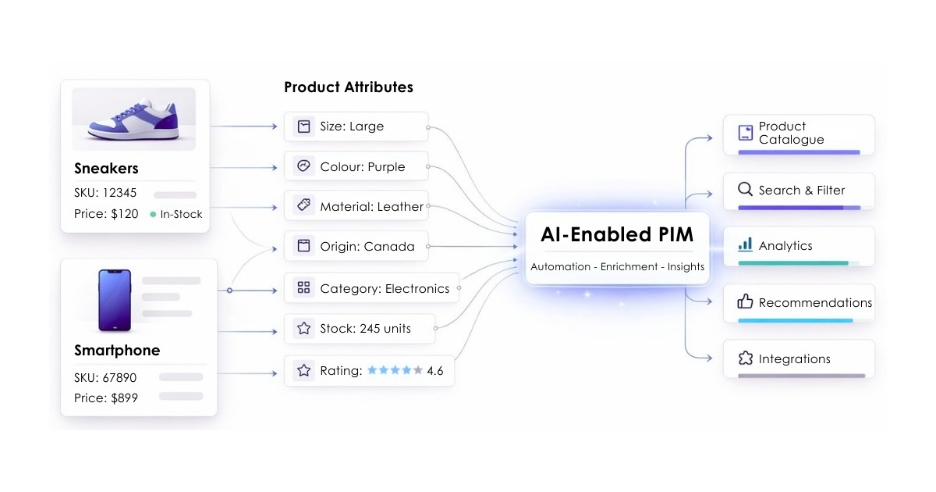
Together, these functions simplify product onboarding while improving data reliability and operational efficiency. This aligns with Gartner’s projection that companies investing in AI-powered digital shelf analytics (DSA) to replace manual data-gathering could reduce operational costs by up to 30% by 2026, highlighting AI’s role in supporting scalable, cost-effective commerce execution.
AI-enabled product information management software also drives value by enhancing the customer journey, sales performance, and responsiveness to changing market conditions. When product data is accurate, complete, and up-to-date, it becomes a strategic growth asset that enables operational success and informed decision-making.
To translate product data into business value, organizations use PIM platforms to deliver seamless interactions across customer touchpoints, resulting in outcomes such as:
By connecting data quality to the purchasing experience and commerce agility, teams can accelerate revenue growth while establishing a foundation for sustained digital innovation across the enterprise.
AI adoption introduces risk alongside its benefits, making governance essential to ensure that data processes remain controlled, traceable, and aligned with defined standards as a foundation for building trust in AI-driven decisions.
To support this, Product Information Management (PIM) provides oversight of both product data and the activities that shape it. It establishes a structured environment where information flows, transformations, and AI-generated outputs are governed through rules and controls, shaped by the following priorities:
When governance is embedded into an AI-enabled product information management system, organizations move from simply handling data to directing how it is used and validated. In turn, trust is built through monitoring and verification, enabling teams to adopt AI while upholding accountability.
Companies adopting product information management software, such as inriver and Akeneo, demonstrate how AI enhances data accuracy, automates key process, and scales product data operations, as illustrated in the following examples:
Together, these examples reveal how AI-enabled Product Information Management (PIM) drives business impact through more efficient product launches, improved content quality, and the ability to manage expanding assortments across markets and channels.
As AI reshapes the commerce ecosystem, Tidal Commerce partners with organizations to implement AI-driven Product Information Management (PIM) strategies that combine automation, governance, and enrichment to manage product data and coordinate workflows. We align technology and operations to assist teams in maintaining accurate information, support efficient launches, and deliver consistent content across channels.
To explore how AI-enabled PIM can support your product data strategy, connect with us. Our team is ready to help you.


Blog
All
.webp)
Blog
All
.webp)
Blog
All
Blog
All
Blog
All
.webp)
Blog
All
Blog
All

Blog
All

Blog
All

Blog
All
Blog
All
.webp)
Blog
All
Blog
All
.webp)
Blog
All
.webp)
Blog
All
.webp)
Blog
All
.webp)
Blog
All
.webp)
Blog
All
Blog
All
.webp)
Blog
All
.webp)
Blog
All
.webp)
Blog
All
Blog
All
.webp)
Blog
All
Blog
All
.webp)
Blog
All
.webp)
Blog
All
.webp)
Blog
All

Blog
All
.webp)
Blog
All
.webp)
Blog
All
Blog
All
.webp)
Blog
All
Blog
All


Get monthly insights, case studies, and bold ideas from the front line of digital commerce & CX.
.svg)
%20dashboard%20showing%20demand%20and%20inventory%20data.%20(1).png)
.webp)
.webp)

.webp)
.webp)
.webp)
.webp)
.webp)
.webp)
.webp)
.webp)
.webp)

.webp)
.webp)
.webp)
.webp)
.webp)
.webp)
.webp)
.webp)
.webp)
.webp)
.webp)
.webp)
.png)
.webp)
.webp)
.webp)